
Written November 2025
How the Metaverse Risks Reinforcing Our Extractive Relationship With Nature — and How It Could Instead Protect What We’re Losing
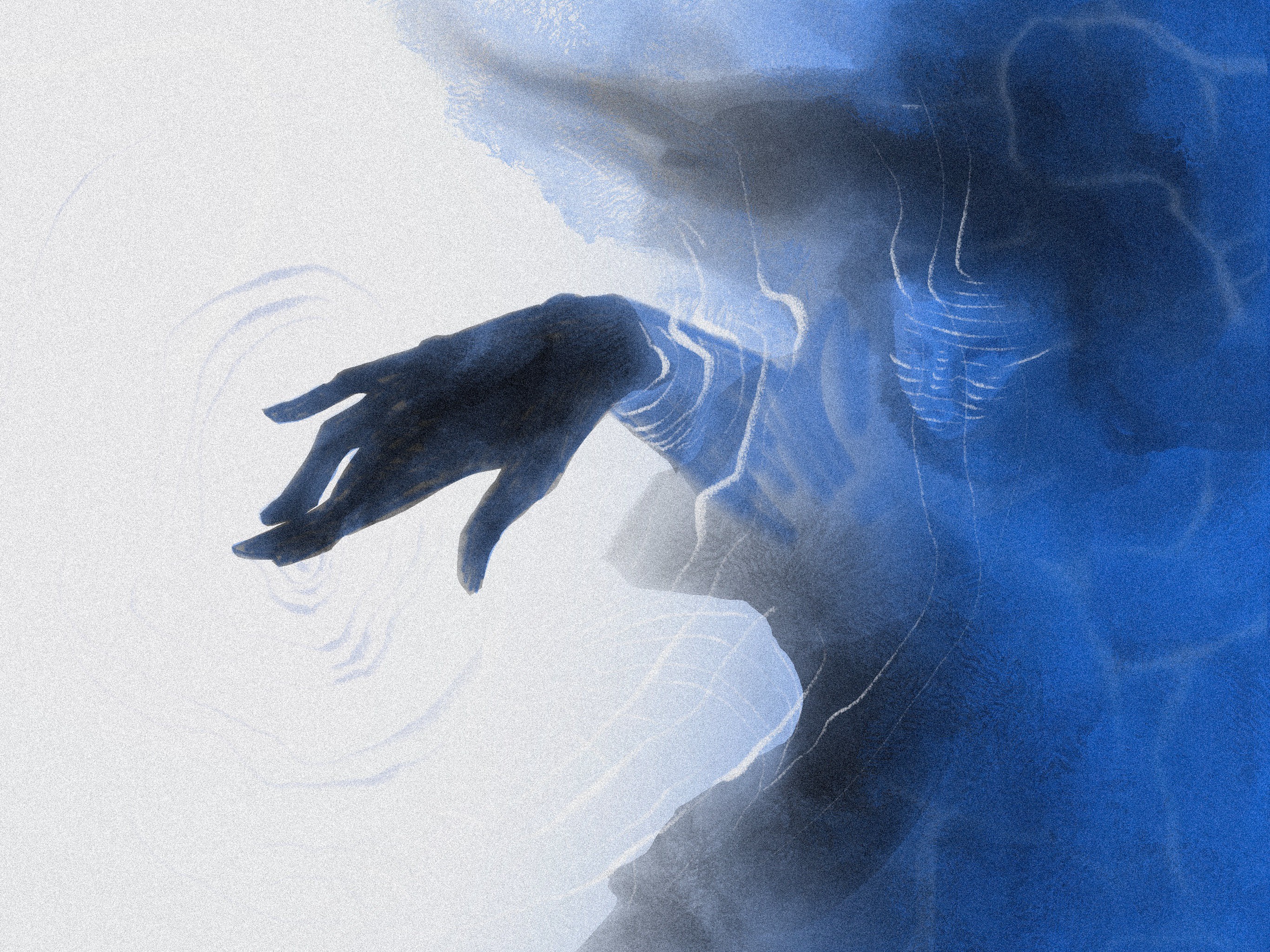
Digital Drawing by Megan Geer
If the value of plants in the physical world has already been flattened into service — shade, beauty, mood enhancement, “greenery” — then the metaverse risks making that flattening complete. Because in a virtual space, a tree really is created purely for decoration, ambience, or gameplay function. Its existence begins and ends with what it does for the user. In this sense, the metaverse doesn’t just mirror our current worldview — it perfects it.
We are already a society that has chlorinated nature: keeping it alive only on our terms. Urban plants are decorative. Animals in our spaces are pests or pets — never equals. Everything non-human has been reduced to an object that can be controlled, curated, and optimized for our convenience. And the deeper tragedy is that this shift was not merely aesthetic. It represents a profound restructuring of how we understand life itself. We’ve replaced a worldview in which human success depended on reciprocal relationship with the natural world with one in which nature exists primarily as a resource to be managed, extracted, or beautified.
The metaverse has the potential to intensify this shift.
Digital Nature as the Perfect Expression of Human Control
In the physical world, plants resist us. They grow unpredictably, die when they want to, reclaim buildings, crack sidewalks, demand seasonal change, and refuse to bloom on command. They remind us that life is autonomous; that it cannot be fully controlled.
But in digital worlds:
Trees grow only when coded.
Landscapes change only when updated.
Seasons occur only when designed.
Biodiversity is optional, artificial, and infinitely adjustable.
Every aspect of “nature” becomes controllable, editable, and bendable to human desire. The metaverse offers a space where nature no longer has agency, logic, or intention. It exists as a set of aesthetic assets, not as a living system. The result is an exaggerated version of our worst habit: total mastery without consequence.
And when nature becomes infinitely manipulable in digital spaces, it reinforces the idea that nature should also behave this way in the physical world. Digital nature could become a kind of training ground for entitlement — a classroom in which users learn that ecosystems should be responsive, predictable, convenient, and obedient.
The Risk of Cultural Overwriting
This brings us to a deeper cultural consequence. Western nations — which already struggle to remember what it feels like to be in relationship with a world that is alive for itself — currently hold the power to design the metaphors, mechanics, and logic of the metaverse. And if the worldview embedded in these digital worlds reflects the dominant Western relationship to nature, then the metaverse could unintentionally pressure other cultures to assimilate to those values. Not through aggression, but through default.
Most Indigenous, animist, and reciprocal cosmologies understand nature as intelligent, alive, self-directed, and relational. But in a digital world where nature exists only as scenery, where no plant or animal has its own motivations, where ecosystems have no autonomy, and where landscape responds only to player input, these cosmologies have nowhere to live.
Design is never neutral.Code is never neutral.
When a digital tree never dies, it teaches people that nature is maintenance-free.When a digital fox exists only to charm, it teaches that animals are commodities.When weather can be toggled in a menu, it teaches that climate exists for convenience.
If future generations grow up interacting with this version of “nature,” the reciprocal epistemologies that still survive — especially outside the West — may be slowly overwritten through lack of representation. Digital worlds could become another frontier where Western modernity unconsciously erases other ways of knowing.
But There Is Also Hope — if We Design For It.
This is the hopeful part: the metaverse doesn’t have to repeat the mistakes of the real world. Because it is invented, it can be reinvented. It could become the first mass-scale environment in modern history designed to restore reciprocity rather than erase it.
Imagine a digital ecology where:
Forests grow on their own logic, not player choice.
Animals follow lifecycles that don’t center human users.
Weather patterns respond to collective behavior.
Ecosystems collapse if mistreated and flourish when tended.
Seasons shift with real-world lunar cycles.
Natural entities exhibit their own agency — refusing to grow, migrating unpredictably, changing over time.
Indigenous and animist worldviews are not flavor-text, but foundational design principles.
In this version of the metaverse, “nature” would no longer be a static backdrop. It would be an active participant. A system with needs, limits, responses, and intelligences of its own. Users would not stand at the center, but within the web.
This would be radical.
It would model a relationship with nature that Western societies have nearly forgotten: nature as a partner, not a product.
Designing Digital Worlds That Protect What We Are Losing
For the metaverse to sustain reciprocal, ecological ways of relating, its “nature” must be built as a living system rather than decorative scenery. This means giving digital environments their own agency and unpredictability — plants that grow and die on their own terms, animals with motivations beyond user benefit, landscapes that resist instant control, and ecosystems that evolve without human command. Multiple cosmologies, especially Indigenous and animist ones, should guide how digital life behaves. User omnipotence should be intentionally limited so relationship, time, and care matter. In essence, the metaverse must model a world where nature acts for itself, not for us.
My Underlying Question
My question, at its core, is this:
Will the metaverse accelerate our alienation from the living world — or can it teach us how to be in relationship again?
I believe answer is not predetermined.It depends entirely on who designs it and what value system they embed at the level of metaphor, mechanic, and code.
If we design the metaverse by default, it will likely repeat and intensify our extractive habits.But if we design it deliberately — with reciprocity, agency, and multiple worldviews — it could become a place where we relearn the relationship that modern Western society has forgotten.
A relationship grounded not in domination, but in humility.Not in service, but in mutual presence.Not in mastery, but in coexistence.
The metaverse could either be the final stage of our domestication of nature — or the first environment in a long time that teaches us how to live with a world that is alive for itself, not for us.