
Written July 2024
What is the difference between using theory as a framework which to interpret ethnographic evidence from fieldwork vs having ethnographic production draw on theory to interpret cultural phenomena as they are encountered?
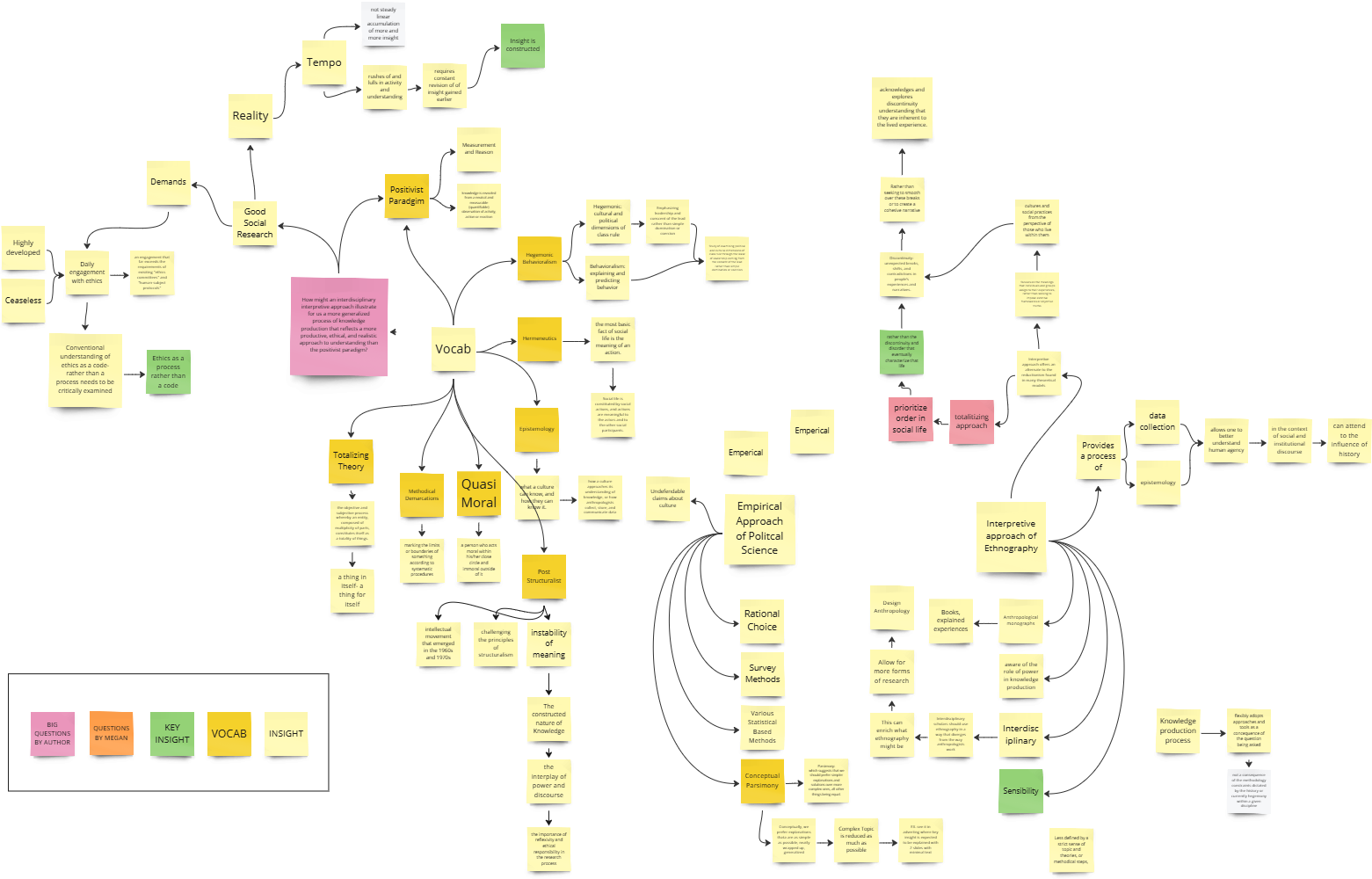
Megan’s Miro Board used to organize information from this book.
Essay in response to Improvising Theory by Allaine Cerwonka and Liisa H. Malkki
What is the difference between using theory as a framework which to interpret ethnographic evidence from fieldwork vs having ethnographic production draw on theory to interpret cultural phenomena as they are encountered?
The short answer: the role and timing of theory in the research process
When using theory as a framework to interpret ethnographic evidence,
THEORY IS A PREDFINED FRAMEWORK OF LENS
You need to select a theoretical perspective before or during the early stages of fieldwork. This can be appropriate when testing a hypothesis derived from theoretical framework or when a researcher is looking to confirm or refine existing theory with ethnographic findings. EX. Using Marxist theory to examine power relationships and class structure within a community, specifically looking for evidence that supports or refines these theoretical constructs.
Strength:
- Validation and Refinement of existing theories, contributing to their robustness and depth
- Insights are more structured and predictable which can spotlight patterns or deviations from the patterns
- These findings can be more reliable within scholarly context and used as references for other projects more easily
Limitations:
- the framework itself might not product insight in the best format that can inform design, it would have to go through more phases or have an adapted structure to be actionable.
When ethnographic production draw on theory to interpret cultural phenomena:
THEORY EMERGES FROM THE ETHNOGRAPHIC PROCESS ITSELF
The engagement with cultural phenomena provides data that guides theoretical insight. This approach is more flexible and responsive to the nuances of the field and it leaves the researcher open to discovering new theoretical perspectives that best explain the observed phenomena. A researcher might begin fieldwork without a specific theoretical lens and, through the process of immersion and observation, develop a theoretical understanding of how local practices and beliefs shape social interactions within the community.
Strength:
- This approach allows for the development of theories that are highly relevant to the specific content being studies, making the insight more applicable to real-world scenarios
- theories and insight generated are more flexible and adaptable to various contexts, like using it as a base design for a product/experience
- insights are more directly actionable because they are derived from the specific context and needs observed in the field
Weakness:
- Insights that attempt to make generalizing theories will face scrutiny in academic circles die to their context-specific nature.
But the main reason why I feel hesitant towards the second method is based on the strength of the insight. For example, when you’re testing an existing theory, the result of the research will act to add more definitions and complexity to the theory or provide specific experiences that do not fit under the generalization made by the theory. All of the insights are in relations to the theory. Of course, I have doubts how helpful this insight is outside of academia, ex. Using research to inform design principles. But it’s in these situations where I think the second method could shine, though I’m not sure how to have ethnographic data not produce generalized theory. I guess that problem is still prevalent in the first method, but I’m not sure what the theory produced from the second method could look like and how it can function and be actionable enough to inform design criteria. I wonder what the prevailing opinion is in 2020-2024?
But isn’t it best to use a combination of these two? It’s important to still be aware of other theories about a topic before you do ethnographic field work.
A part of the fieldwork could be to prove/disprove a theory while and another part could be to create theory based on the experience. Maybe the first is done in micro case since it can be more emprtically valid and provide a position and opinion on the theory which is then followed up by robust fieldwork. The only possible problem is the confimarion bias that one can be brining into the fieldwork. But as we’re exploring though this book, that will always be a factor regardless and we just need to accept, be aware, and factor it into our process.
When researching new methods, here are two prevailing approaches that caught my attention
Pragmatic Ethnography that focuses on generating insight that are immediately applicable and actionable. This is used in fields like UX and policy making
Design Anthropology which is the blending ethnographic methods with design thinking to produce insights that directly inform design criteria. It’s an iterative process where ethnographic findings are continuously fed into the design process to create more user-centered design. Similar to running a project Agile.
Design Anthropology is something I am very interested in persuing.